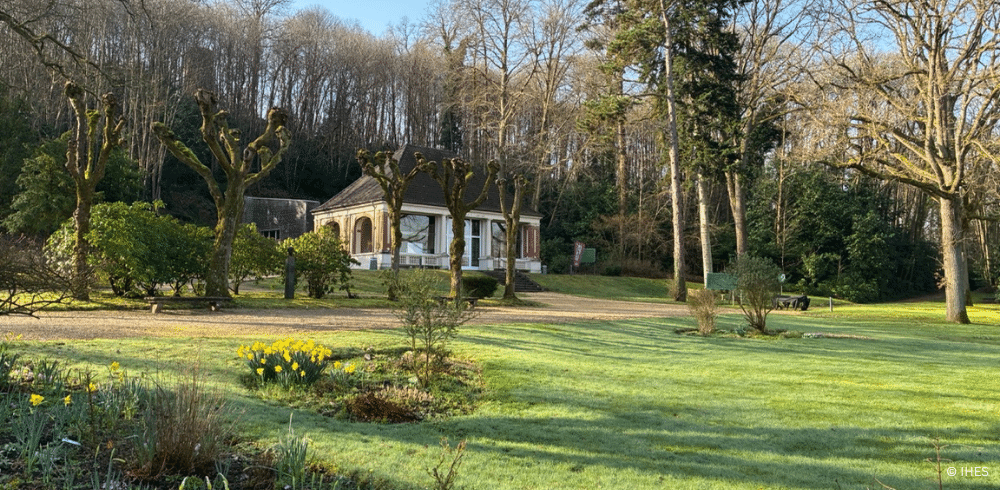
Shaping the Future of Knowledge: Discover IHES and the Power of Long-Term Research
The Institut des Hautes Études Scientifiques (IHES), a founding member of Université Paris-Saclay, is an internationally renowned research institute dedicated to advancing fundamental knowledge in mathematics and theoretical physics. Since its creation in 1958, IHES has provided a unique environment where some of the world’s most influential scientists are given the time, freedom, and support to pursue long-term research at the boundaries of current scientific knowledge
Designed as a place for reflection and intellectual exchange rather than formal teaching, the Institute brings together a small community of permanent professors and visiting researchers from around the world. In this setting, ideas can develop over years through dialogue, collaboration, and independent exploration, contributing to breakthroughs that have shaped modern science and continue to influence future generations of researchers.
This is precisely the kind of environment that Fondation de France is helping to sustain and support, notably through support for the recruitment of Junior Professors. By enabling the Institute to attract outstanding early-career researchers, this initiative helps ensure that exceptional knowledge, mentorship, and scientific curiosity are passed on to the next generation of mathematicians and physicists.
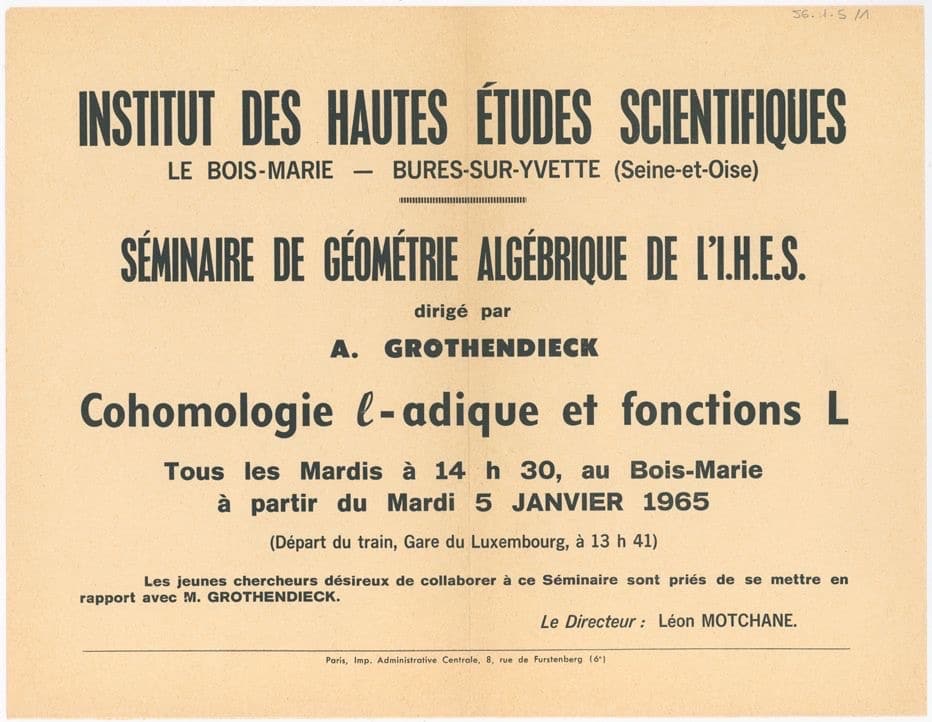
IHES has been the birthplace of several major breakthroughs in mathematics and theoretical physics. Could you share one example that you feel particularly illustrates how the Institute’s environment helped an idea develop in a way that might not have been possible elsewhere?
A clear example is Alexander Grothendieck’s work in algebraic geometry. At IHES, he had the freedom and time to focus on fundamental questions, while being part of a highly stimulating community. This environment enabled him to develop revolutionary concepts such as schemes and toposes, which completely transformed modern mathematics.
Another example, this time in physics, is Thibault’s Damour’s foundational work on general relativity. Professor Damour was hired as a Permanent Professor at IHES in 1992, and his research on the “Effective One Body Method” played a crucial role in the detection of gravitational waves in 2015.
The Institute’s culture of long-term exploration and interdisciplinary dialogue is crucial for ideas of this depth to emerge.
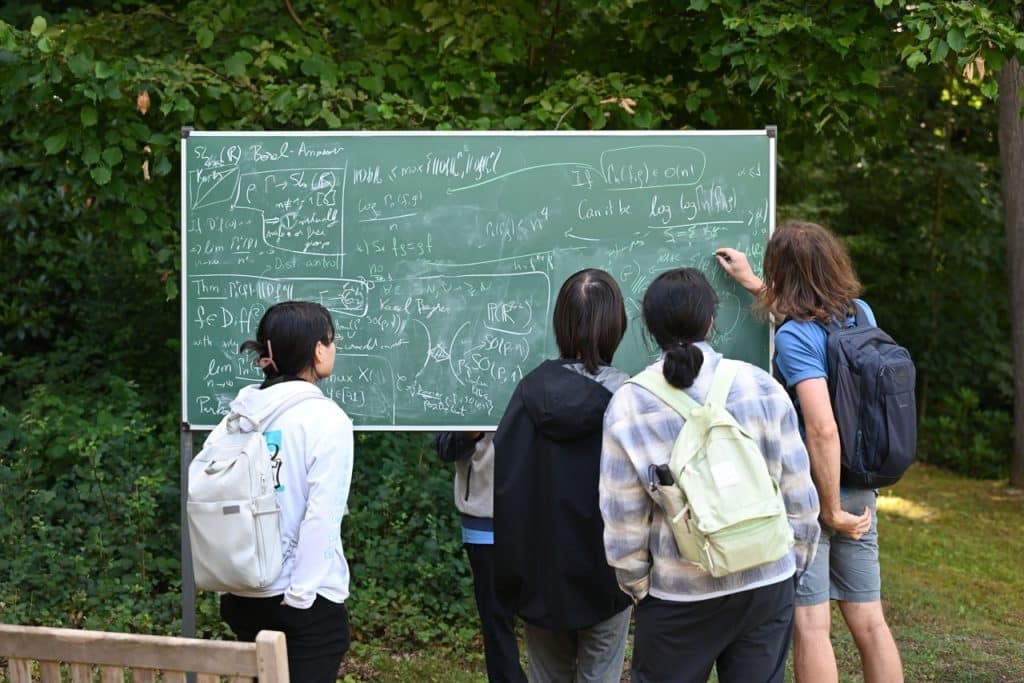
What qualities or ways of thinking does IHES look for when identifying the next generation of researchers who will carry forward its scientific legacy?
IHES seeks to recruit researchers who combine intellectual boldness with curiosity, initiative, and creativity. Exceptional scientific excellence and the ability to navigate across disciplines are essential. The Institute also strongly values international collaboration as diverse backgrounds foster stimulating exchanges and cross-disciplinary innovation.
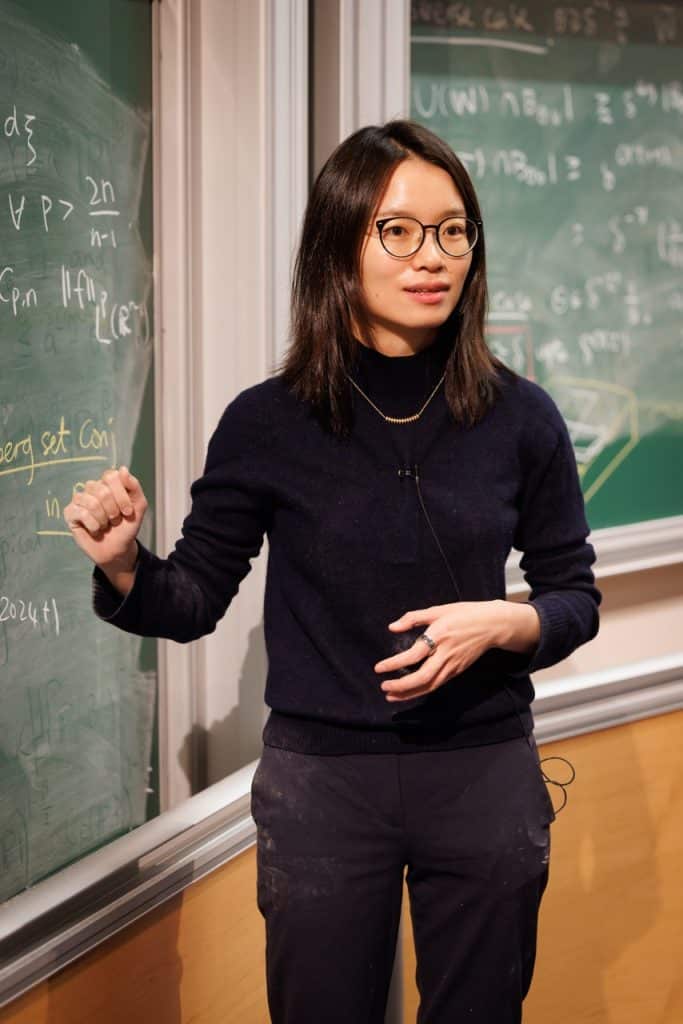
For donors who may not have a scientific background, how would you describe the impact of supporting fundamental research that has no immediate or visible application?
Supporting fundamental research, even without immediate applications, is an investment in the long-term advancement of knowledge. Many important scientific and technological breakthroughs have originated from work that was initially purely theoretical. By supporting IHES, donors enable researchers to explore foundational questions that could one day transform our understanding of the universe and have far-reaching, often unforeseen, impacts on society.
In a world increasingly driven by immediacy and measurable outcomes, IHES stands as a powerful reminder that some of humanity’s most transformative discoveries begin as quiet, patient explorations of the unknown. Through sustained support for IHES, we help preserve a space where curiosity is protected, excellence is nurtured, and discoveries that shape the world are given the time they need to emerge.
To learn more about the pioneering research, academic community, and long-term vision of Institut des Hautes Études Scientifiques (IHES), please visit their website: https://www.ihes.fr/en/.
By supporting the recruitment of Junior Professors and sustaining this rare ecosystem of long-term inquiry, you can help to ensure that the next generation of pioneering thinkers can pursue questions whose answers may not yet be imaginable.